When a Queens fire escape needs welding, the job doesn’t stop at the weld. Our in-house crew repairs the connection, prepares the steel, and restores the protective coating under one scope.
A visible crack at a joint, a separated connection, or a bracket pulling away from its original position can indicate a failed connection. The important question is not simply whether a bead can be added. It is whether the connection still carries the intended load path and whether the surrounding steel is sound enough to receive the work.

Brackets connect the escape to the building and transfer forces back into the structure. Corrosion around a bracket, an open joint, or movement at the connection can change how the assembly works. Before joining anything, the affected area needs to be assessed for section loss, anchorage condition, and access.

When corrosion has reduced structural steel enough that the original member cannot be retained, new steel may become part of the solution. The extent of deterioration matters. Localized loss may be addressed within a repair scope but widespread deterioration can cross the replacement threshold.
Want to know when replacement is the answer? Check here.

A joining operation does not make every damaged fire escape repairable. Severe section loss, failed anchorage, compromised load paths, or deterioration extending beyond the practical repair area may require replacement or broader restoration. Our team of experts identifies that boundary rather than treating every defect as a reason to weld.
A new joint leaves exposed steel around the repaired area. Heat and surface disturbance can also affect the surrounding coating. If that area sits unprotected between trades, moisture can reach the bare metal before the protective system is restored. That is where corrosion can begin again.
After the structural work, the joint is prepared for coating. Grinding removes unwanted residue and helps establish a surface suitable for the specified coating system. The surrounding area also has to be checked for loose coating, contamination, flash rust, and other conditions that could undermine adhesion.
The exposed steel receives the specified rust-inhibitive primer before the topcoat is applied. Primer selection, film build, cure time, and the recoat window all affect how the protective system performs. The objective is to return it to a coherent protective coating system.
We use one crew for the structural joining and the subsequent coating work. The written warranty applies to the specified coating system, including the coated repair area, subject to the supplied warranty terms.
When one trade leaves a bare repaired joint for another trade to finish, responsibility can become divided. That’s why the same crew handles the joining, preparation, primer, and coating; one scope, one point of accountability.
Heat, sparks, and slag can damage nearby finishes even when the actual joint is small. Windows, sills, masonry, painted surfaces, and other exposed areas need appropriate shielding and protection before work begins.
Hot work requires controls around ignition sources and nearby combustibles. A fire watch may be necessary depending on the work and site conditions. Specific permitting and safety requirements should be confirmed for the planned operation rather than assumed from another project.
Many Queens fire escapes sit above public sidewalks. The work area therefore has two environments to manage: the building and the people moving below it. Access control, shielding, and sidewalk protection should be planned around the actual location and work method.
Occupied buildings add another layer. Tenants may need notice about access restrictions, window proximity, noise, or temporary limitations around the work area. Scheduling should account for the building’s occupied conditions instead of treating the escape as an isolated piece of steel.
Duration depends on what has failed, how accessible the joint is and how much surrounding material needs preparation. We identify whether protective coating can be completed in the same work window.
Several affected locations add access, setup, and coordination requirements. The number of joints alone does not establish a reliable duration. The condition of each connection and the building layout matter.
Structural work may be complete before the protective coating reaches its required cure or recoat condition. Weather, surface condition, access, and coating requirements can therefore affect the overall sequence.
As a general reference: a single joint repair with coating restoration is typically a one-day job. Multiple connections across three or more floors with full preparation and coating can run three to five days. Weather and coating cure windows affect the outer end of that range
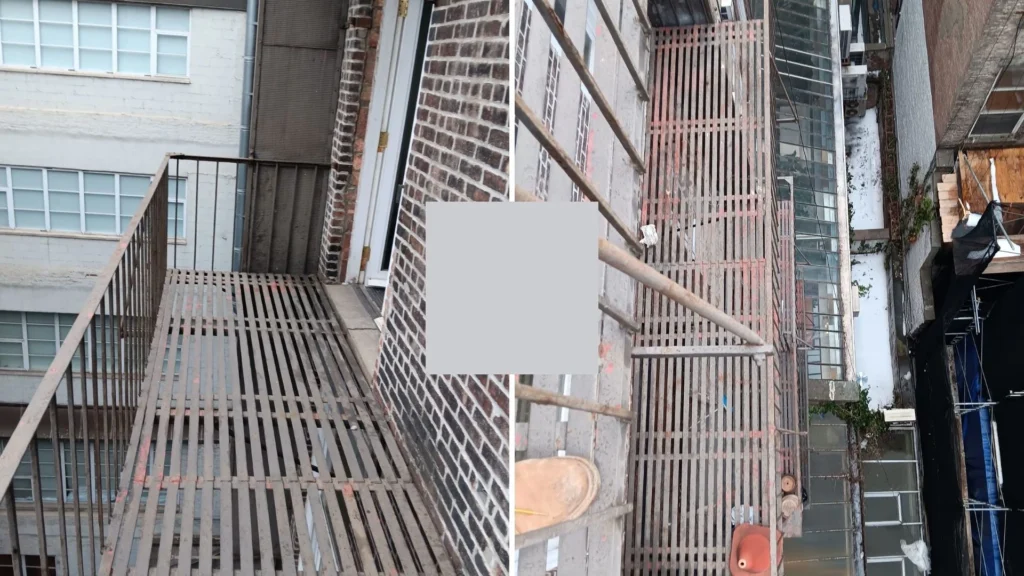
8-18 Queens Plaza South, 11101; Inspection & Welding, 2022
In 2022, we combined structural inspection and welding at this commercial property in Long Island City. The inspection identified localized section loss at several connections. We completed targeted welding repairs without requiring full structure replacement, then restored the protective coating system across the repaired areas under the same crew and scope.
This commercial infrastructure required careful integrity validation to ensure absolute stability and local compliance. Our specialized teams performed meticulous visual tracking and code-compliant welding repairs. We successfully corrected localized section loss without requiring a full system replacement.
It can be part of a repair scope when a failed joint, bracket, or connection can be safely restored without replacing the larger structure. The structural condition determines the scope, while full replacement or restoration belongs with the appropriate service.
There is no reliable fixed duration without seeing the connection. Access, the number of affected joints, surrounding corrosion, preparation, and coating cure requirements all influence the schedule.
Structural joining by itself does not establish compliance. The completed work must be appropriate to the condition of the structure and any applicable NYC requirements, while agency or professional determinations remain outside a contractor's control.
Potentially, but occupied conditions require planning around windows, access, combustibles, sparks, noise, and pedestrian protection. The work area and hot-work precautions should be assessed before scheduling.
Yes, assessments can be planned around occupied buildings and tenant access. Scheduling should account for windows, egress, building access and the conditions around the exterior work area.
Send a photo or call (718) 750-3967. Our in-house welding and painting crew handles the repair and protective coating under one scope, with $2M in general liability coverage.

We’ve been working with Queens property owners since 2004. Whether the structure needs coating, repair, welding, or restoration, we keep the work with one accountable crew.
Copyright © 2026. All rights reserved.